

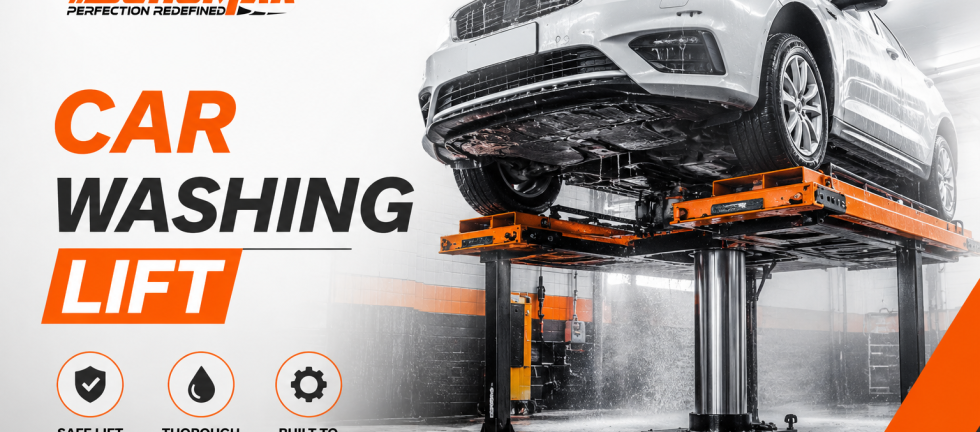
No matter if you are running a detailing studio or a busy car wash, every car detailer will eventually reach the same barrier: you can clean a car only to the extent at which you can reach it. That problem can be solved with the application of washing lifts.
Instead of bending under the bumper or reaching over the hood, the washing lift will lift up the car to the needed height thus facilitating the job. In this article you will find the answers to the questions regarding washing lift, the main types existing in the market, the benefits it brings to the car wash business, and how to choose the one you need.
What Is a Washing Lift?
Washing lift, which is also referred to as car washing lift, is a machine which is made and designed for lifting a car and washing it comfortably. During washing, the car can be washed and rinsed properly while standing.
It is different from normal repair lift because it is made in those conditions where water is constantly used as washing takes place. Schumak, for example, has the ability to provide hydraulic washing lift equipment that varies in its designs, specifications, and prices to accommodate for the needs of customers from one-bay detailer to the commercial wash.
Why a Washing Lift Changes How You Clean a Vehicle
Washing a car at ground level has a hard physical limit; you can’t get consistent access to the underbody, wheel arches, rocker panels, and lower door edges without kneeling or awkwardly reaching. A washing lift removes that limit entirely.
By raising the vehicle to a comfortable working height, it gives the operator a clear line of sight and reach to every panel, including the areas that collect the most road grime, brake dust, and undercarriage buildup. This directly affects wash quality grime that’s missed at ground level because it’s hard to see or reach and doesn’t get missed on a raised vehicle, which is often what separates a basic wash from a premium service customers pay more for.
Types of Car Washing Lifts
Washing lifts aren’t sold as a single generic product capacity, platform design, and lifting mechanism all vary depending on the vehicles being serviced. Schumak Equipment’s (I) Pvt Ltd, an ISO 9001 and CE-certified automotive garage equipment manufacturer based in Coimbatore, Tamil Nadu, produces hydraulic washing lifts across several configurations, which is a useful reference point for understanding how the category is actually structured in practice.
Single-Plunger Hydraulic Lifts (1, 2, and 4 Ton)
These use a single hydraulic plunger to raise a spider-type, adjustable platform, and are suited to passenger vehicles and light commercial vehicles. Schumak’s 4 Ton – Standard H Type model, for example, uses one plunger with a 270mm diameter, reaches a lifting height of 1,500mm (1,700mm optional), and runs on an air pressure requirement of 9–12 kg/cm², with a 150-litre oil tank capacity. Variants at this capacity level include a Standard H-Type, Spider Arms design, and Tyre Rest Platform (TRP) In-Built and TRP Pro configurations, each adjusting how the vehicle’s tyres are supported during lifting.
Standard and TRP Platform Lifts (8 Ton)
At higher capacity, 8 Ton washing lifts are built for heavier vehicles and higher-frequency commercial use, available in Standard and Tyre Rest Platform (TRP) Pro configurations depending on how much additional wheel and tyre support the workshop needs during washing.
Twin Post Lifts (8, 16, and 25 Ton)
For the heaviest-duty applications larger commercial vehicles and high-volume fleet washing twin post lift designs scale up to 16 Ton and 25 Ton capacities, offering a stable, dual-column lifting structure suited to sustained daily use in demanding workshop environments.
Key Features That Define a Reliable Washing Lift
Beyond raw lifting capacity, the engineering details of a washing lift determine how well it holds up in a wet, high-traffic wash bay. Based on Schumak’s specifications for its H-Type hydraulic washing lift, the features that matter most include:
- Wiper ring design prevents water and dirt from entering the hoist cylinder, which is critical for equipment operating in constant wash-bay moisture.
- High-performance gland rings improve overall operational efficiency of the hydraulic system.
- Hard chrome-plated steel plungers precision-engineered for superior wear resistance under repeated daily lifting cycles.
- Indoor and outdoor installation support giving flexibility depending on the wash bay’s layout and available space.
- Adjustable spider-type platform accommodates a range of passenger and light commercial vehicle sizes on the same unit.
Key Benefits of Using a Washing Lift
- Full underbody and wheel-well access reaches the areas most prone to accumulated dirt, salt, and grime that are nearly impossible to clean thoroughly at ground level.
- Reduced physical strain on staff brings the work to a comfortable height, reducing fatigue and the risk of repetitive strain injuries over a full shift.
- Faster service times, better visibility and reach mean less repositioning and more actual cleaning, directly increasing throughput.
- More consistent wash quality with every panel easier to see and reach, less gets missed across every vehicle serviced.
- Better suited to premium detailing services makes close-up work like paint correction and ceramic coating far more manageable than working around a vehicle on the ground.
Washing Lift vs. Standard Automotive Lift
Not every automotive lift is suitable for a wash environment. A washing lift needs to handle constant water exposure, drainage, and the corrosive effects of soap, chemicals, and road residue conditions a standard repair-shop lift isn’t necessarily built to withstand long-term. Features like a wiper-ring cylinder seal and hard chrome-plated plungers, as used in Schumak’s washing lift range, exist specifically to address this general-purpose lifts typically aren’t engineered around the same level of moisture exposure.
How to Choose the Right Car Washing Lift
- Available floor space Twin post lifts and larger-capacity models need more room, while lower-capacity single-plunger lifts suit tighter bays.
- Lift capacity Match the rated capacity to your heaviest regular vehicle type. Schumak’s range spans 1, 2, 4, and 8 Ton single-plunger and standard/TRP models up to 16 and 25 Ton twin post lifts for heavier-duty use.
- Platform type A Tyre Rest Platform (TRP) configuration offers additional wheel support during washing, which can matter for certain vehicle types or workshop preferences, compared to a standard spider-arm platform.
- Water and chemical resistance Since a washing lift operates continuously in a wet, chemical-exposed environment, look for cylinder protection (such as a wiper ring design) and corrosion-resistant components.
- Certification Confirm that the company has the certifications for quality and safety satisfactory. For example, Schumak has been recognized with the status of being ISO certified.
- Manufacturer track record The experience of a company acts as a barometer for its reliability. For example, Schumak Equipments (I) Pvt Ltd has been in existence for over 25 years providing good quality automotive tools for OEM workshops and filling up the needs of private garages. Their clients include big names such as Maruti Suzuki, Hyundai, Mahindra, and Tata Motors.
For businesses evaluating suppliers directly, schumakindia.in lists its full washing lift range from 1 Ton up to 25 Ton twin post models along with downloadable brochures and specification sheets for each capacity, which makes it easier to compare models before requesting a quote.
Common Use Cases
- Professional car wash stations – Higher-capacity or twin post lifts to speed up throughput while improving wash thoroughness.
- Detailing studios – Single-plunger lifts with strong underbody and wheel-well access for paint correction, ceramic coating prep, and deep-clean services.
- Fleet washing operations – 16 or 25 Ton twin post lifts for consistent access to larger commercial vehicles.
- OEM and dealership workshops – Reliable, certified equipment suited to manufacturer-affiliated service standards, similar to the client base Schumak has built across major Indian automotive brands.
Installation and Long-Term Reliability
Before purchasing a washing lift, it’s worth thinking through installation: floor load capacity, drainage placement, and whether the unit will be installed indoors or outdoors, since this affects which configuration is most suitable. Working with an established manufacturer also matters for long-term reliability.
Companies like Schumak, with a dedicated engineering department and field support team, are generally better positioned to support maintenance and part availability over the equipment’s working life. Buyers can review the full product specifications and request installation guidance directly through schumakindia.in, where each washing lift model is listed with its technical datasheet.
Frequently Asked Questions
What is a car washing lift used for? A car washing lift raises a vehicle to a comfortable working height so it can be washed, rinsed, and detailed with full access to the underbody, wheel wells, and lower panels.
What washing lift capacities are commonly available? Capacities typically range from 1 Ton single-plunger lifts for passenger vehicles up to 25 Ton twin post lifts for heavy-duty commercial vehicle applications, with 2, 4, 8, and 16 Ton options in between.
What’s the difference between a standard platform and a TRP washing lift? A Tyre Rest Platform (TRP) configuration provides additional support under the vehicle’s tyres during lifting, while a standard spider-arm platform is adjustable to suit a broader range of vehicle sizes.
Do washing lifts need certification? Reputable manufacturers hold recognized quality certifications for example, Schumak Equipment’s (I) Pvt Ltd is an ISO 9001 and CE-certified manufacturer, which reflects consistent build and safety standards across its washing lift range.
How do I choose the right lift capacity? Base your decision on the heaviest vehicle type you regularly service, not an average a 1 or 2 Ton lift suits standard passenger cars, while fleet or commercial vehicle operations typically require 8 Ton and above.
Final Thoughts
A washing lift is one of the most practical upgrades a car wash or detailing business can make, directly improving both the speed and quality of every vehicle serviced. Whether it’s a compact 1 Ton single-plunger lift for a detailing studio or a 25 Ton twin post lift for heavy commercial use, the right car washing lift comes down to matching capacity, platform type, and build quality to your specific workshop needs.
Manufacturers with an established track record such as Schumak, in operation since 1999 and certified to ISO 9001 and CE standards are worth prioritizing, and their full washing lift lineup can be reviewed directly at schumakindia.in before making a purchasing decision.