

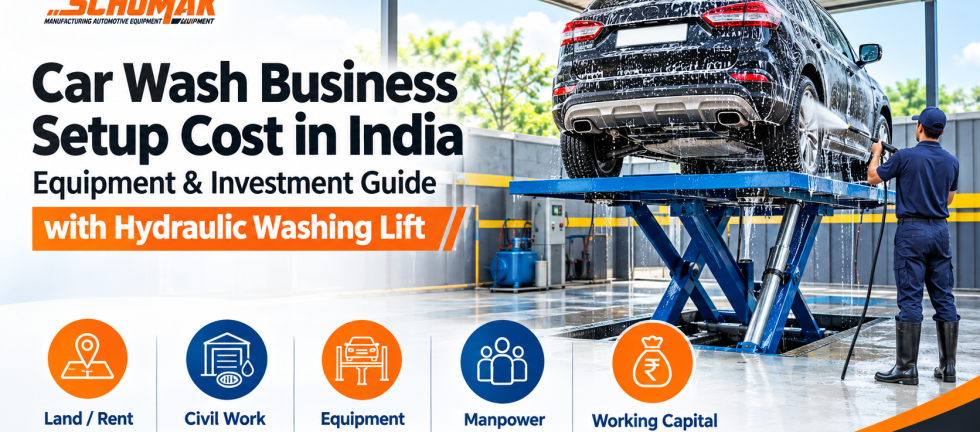
In India, opening a car wash venture may cost from roughly Rs 5 lakh for a small manual facility to more than Rs 20 lakh for a fully equipped multi-bay facility. You will have to make the most significant choice in terms of equipment, which is selecting the hydraulic washing lift, because it determines how many cars can be serviced in a day and how easily and safely you can work under the cars. This guide presents all cost items – from civil works to equipment – so you can create a budget based on real figures.
Total Car Wash Business Setup Cost in India
A car wash business has five major cost heads: land or rent, civil work and drainage, equipment, manpower, and working capital. Together these decide your final investment figure.
Land or rented space usually costs the most in metro cities, while civil work covering flooring, drainage, and water treatment can run from Rs 1 lakh to Rs 3 lakh depending on the number of bays. Equipment is the second largest head, and this is where most first-time owners either overspend on unnecessary machines or underspend on the core hoisting equipment. Manpower for a 2-3 bay setup usually needs 4 to 6 washers along with one supervisor, and working capital should cover at least two to three months of consumables, water, and salaries before the business becomes self-sustaining.
Hydraulic Washing Lift Price and Capacity Options in India
This equipment is priced based on its load capacity, lifting height, and whether it is a single post, twin post, or scissor type design. Prices in India currently range from around Rs 21,500 for a basic two wheeler service jack to over Rs 3,35,285 for a heavy duty bus washing lift.
Here is a realistic price range for washing lifts and jacks manufactured in India:
| Product | Price |
| Two Wheeler Service Jack | Rs 21,500/Unit |
| Two Wheeler Washing Jack | Rs 42,500/Unit |
| Three Wheeler Washing Jack | Rs 47,118/Unit |
| Hydraulic Two Wheeler Washing Lift | Rs 73,740/Unit |
| 4 Tons Car Washing Lift | Rs 1,29,858/Piece |
| Car Washing Lift With Tyre Rest Platform | Rs 1,72,143/Unit |
| Hydraulic Service Lift | Rs 1,89,000/Unit |
| 2SP-08, 8 Tons Twin Post Truck Washing Lift | Rs 2,52,450/Unit |
| Bus Washing Lift | Rs 3,35,285/Unit |
If you are only servicing two wheelers, a basic jack in the Rs 21,500 to Rs 73,740 range is enough. For a standard car wash business handling sedans and SUVs, the 4 ton car washing lift or the tyre rest platform variant covers most day-to-day needs. Businesses planning to service commercial vehicles or buses should budget for the twin post or bus washing lift models, since undersizing your hydraulic washing lift is one of the most expensive mistakes you can make later.
Complete Equipment List for a Car Wash Business
Beyond the main lift, a functional car wash needs pressure washing, air supply, and lubrication equipment. Here is what a complete setup typically includes, with current Indian market prices.
Air Compressors
| Product | Price |
| 1 HP Three Cylinder Air Compressor | Rs 42,231/Unit |
| 5HP Two Stage Air Compressor | Rs 90,642/Unit |
| High Pressure Air Compressor | Rs 1,80,000/Unit |
| Screw Air Compressor | Rs 3,00,000/Unit |
| Twin Cylinder Air Compressor Pump | Rs 3,55,000/Unit |
Vehicle Washers
| Product | Price |
| High Pressure Car Washer | Rs 42,284/Piece |
| VW-02-35-3 Triple Plunger Vehicle Washer | Rs 62,014/Unit |
| VW-03-35-3 Triple Plunger Vehicle Washer | Rs 68,668/Piece |
| Single Plunger Vehicle Washer | Rs 77,178/Piece |
Grease Pumps
| Product | Price |
| Hand Operated Grease Pump | Rs 2,250/Unit |
| HGP10 Hand Operated Grease Pump | Rs 3,100/Unit |
| Pneumatic Grease Pump | Rs 17,482/Unit |
| Air Pneumatic Grease Pump | Rs 18,356/Piece |
| 50 Kg Hand Operated Grease Pump | Rs 17,999/Unit |
Accessories and Wheel Service
| Product | Price |
| Lance Holder | Rs 4,900/Unit |
| Chassis Wash System | Rs 22,714/Unit |
| Digital Tyre Inflator | Rs 32,000/Number |
| Rotating Washing Boom | Rs 34,885/Piece |
| Nitrogen Tyre Inflator | Rs 97,850/Unit |
| Wheel Balancer | Rs 1,13,000/Unit |
Most small car wash businesses start with a high pressure car washer, one air compressor, a hand operated grease pump, and one washing lift, then add tyre inflators and wheel balancers as revenue grows.
Why a Hydraulic Washing Lift Is a Core Equipment Investment
The item in question is not merely a thing of convenience; this is an apparatus responsible for determining the vehicle’s capability for the day. Without this device, tasks involving undercarriage wash, rust assessment, and lubrication handling will take considerably more time, thus exposing the employees to uncomfortable and hazardous postures.
Manufacturers with ISO 9001:2015 quality management system certification make these equipment with tested steel frames and hydraulic cylinders that allow the lift to function daily as the device will get lifted and lowered at least 15 or 20 times a day. Knowing this fact, you will understand that if you choose a hydraulic wash lift manufactured by reliable and experienced manufacturers, it will result in decreased downtime and savings for you in terms of money spent over the device’s operating period of 10 to 15 years.
How to Choose the Right Capacity for Your Garage
The capacity of the hydraulic washing lift must be matched to the most massive vehicle, not just average weight. A garage dealing with SUVs or light commercial vehicles sometimes should not rely on lift capacity rated for hatchback cars only, as pushing the lift to its rated capacity is an unsafe thing to do and causes loss of the manufacturer warranty. If in doubt, it is always better to select one size higher than required to meet your needs, as demand for SUVs or bigger cars is only growing in Indian cities.
Expected ROI and Break Even for a Car Wash Business in India
Most car wash businesses in India recover their initial investment within 18 to 30 months, depending on footfall, pricing, and how efficiently the equipment is used. A single 4 ton hydraulic washing lift bay handling 25 to 35 vehicles a day at an average ticket size of Rs 150 to Rs 300 can generate meaningful daily revenue once fixed costs like rent and salaries are covered.
Break even happens faster in high traffic locations near residential complexes, highways, or commercial hubs, since underutilized equipment is the main reason ROI timelines stretch beyond two years.
Licenses and Compliance Checklist
Make sure you check with local authorities before starting out with your business to ensure that you have the following documents: (1) Trade license from the municipal corporation. (2) GST Registration (3) Clearance for water usage and effluent discharge from the local pollution control board (4) Fire safety clearance if using flammable cleaning agents (5) Electrical safety certification for your lift installations and compressors. Each state has its own requirements, so check with local consultant to finalize your site.
Common Mistakes First Time Car Wash Owners Make
One of the biggest error is to select a hydraulic washing lift that is too small to reduce initial costs, which ends up causing capacity issues later on as cars in India become larger, for example, more SUVs and MUVs. Secondly, skipping the planning of drainage and water treatment can lead to waterlogging and costly construction work later. Finally, underestimating the number of people needed means that production cannot be done quickly even if the equipment has the capacity to wash more cars per day.
Why Schumak Is a Reliable Choice for Your Hydraulic Washing Lift
Schumak Equipment (India) Pvt. Ltd. has been manufacturing and exporting automotive and garage equipment since 1999, and is an ISO 9001:2015 certified firm based in Coimbatore, Tamil Nadu. Its product range covers hydraulic washing lifts, air compressors, pneumatic grease pumps, digital tyre inflators, vehicle washers, and tyre changers, along with three wheeler washing jacks, cranes, and two post mechanical jacks. Beyond the Indian market, Schumak also exports its equipment to the Middle East and the wider Indian Subcontinent. For a first-time car wash owner, working with a manufacturer that has over two decades of manufacturing experience and formal quality certification reduces the risk of equipment failure and gives you a dependable source for spares and after-sales support.
Frequently Asked Questions
What is the price of a hydraulic washing lift in India? Prices range from around Rs 21,500 for a basic two wheeler jack to over Rs 3,35,285 for a heavy duty bus washing lift, depending on capacity, lifting height, and design type.
How much does it cost to start a car wash business in India? A small manual car wash can start from around Rs 5 lakh, while a fully equipped multi-bay station with a hydraulic washing lift, compressors, and vehicle washers can cost Rs 15 lakh to Rs 20 lakh or more.
What capacity hydraulic washing lift do I need for a car wash? For sedans and SUVs, a 4 ton lift is generally sufficient. For commercial vehicles or buses, a twin post lift rated at 8 tons or higher is recommended.
How long does it take to break even on a car wash business? Most car wash businesses in India break even within 18 to 30 months, depending on location, footfall, and how efficiently the hydraulic washing lift and other equipment are utilized.
Conclusion
Setting up a car wash business in India comes down to planning your budget across land, civil work, equipment, manpower, and working capital, with the hydraulic washing lift standing out as the single most important equipment decision you will make. Choosing the right capacity from a certified manufacturer protects both your team and your investment over the long run. If you are ready to compare capacities and plan your equipment list, visit Schumak India to explore pricing and manufacturer support built on 25 years of experience.