

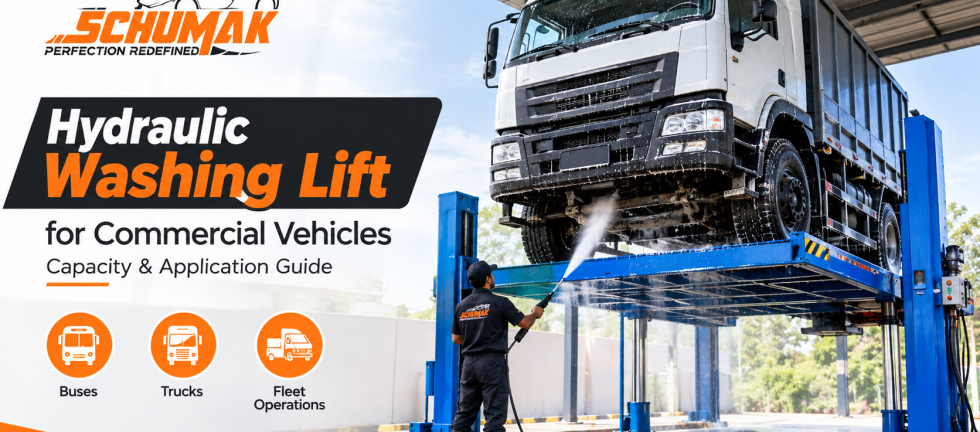
Washing a bus, truck or heavy fleet vehicle properly means reaching the underbody and doing that safely at scale is not something a pit or a standard ramp handles well. A hydraulic washing lift solves this by raising the vehicle to a comfortable working height but commercial vehicles bring very different capacity and configuration demands compared to a standard passenger car setup. This guide covers construction, capacity, applications and what to check before buying one for a fleet or commercial washing operation.
Construction, Capacity and Key Features of a Hydraulic Washing Lift
This equipment is a platform that raises a vehicle off the ground typically between 600 mm and 1,800 mm giving technicians full access to the underbody, for washing, inspection and routine maintenance. The system relies on a pump and cylinder assembly.
When the operator activates the control valve, pressurised hydraulic fluid extends the cylinder. Raising the platform while releasing the valve holds the vehicle at the desired height and reversing the flow lowers it smoothly.
For commercial vehicles specifically, column or post-style lifts are the configuration that matters most. Two‑post and four‑post column lifts give more steadiness for heavy cars and the open floor lets technicians move easily below. A scissor lift simply cannot match this at weights.
Two‑post and four‑post column lifts are especially useful when lifting cars that weigh more than 3.5 tons. Four‑post designs are the choice for these heavy vehicles and they normally can lift between 4 and 6 tons – well beyond what a typical car scissor lift can handle. Most new lifts have safety locks that engage automatically at set heights preventing accidental lowering.
Beyond the locking mechanism, a properly specified unit should include overload protection valves that prevent operation above the rated safe working load, an emergency lowering valve for power-cut scenarios, and anti-skid rubber pads on the platform surface.
Always verify the SWL plate on the equipment. Make sure to cross-reference it with the manufacturer’s certification documentation before using it for commercial loads. This step is essential to ensure safety and compliance.
Applications for Commercial Vehicles: Buses, Trucks and Fleets
Column and post-style lifts work in full-service garages, fleet service centers and dedicated truck and bus wash operations. These settings often involve vehicles and require open-floor access under the vehicle. That makes lighter scissor-type lifts impractical.
A four-post hydraulic washing lift rated at 4 to 6 tons can easily handle buses, heavy trucks and light commercial vehicles. It’s more capable than a 2-ton passenger-car-rated unit, which would quickly become overloaded, under such use.
Fleet operators especially benefit from this type of equipment. The consistency it offers helps maintain operations. Each vehicle gets the level of support during servicing. There’s risk of equipment failure or delays. The performance stays steady across shifts and locations.
Washing multiple vehicles a day with full underbody access, rather than relying on manual crawling or partial ramp access, directly increases how many vehicles a bay can process while reducing technician fatigue and injury risk from awkward postures.
It becomes more important at commercial scale, where a single bottleneck vehicle can slow down an entire fleet’s turnaround schedule. Beyond washing the same underbody access allows commercial operators to add services such as underbody anti‑rust coating, tyre rotation and brake inspection turning a wash bay into a broader maintenance touchpoint, for fleet vehicles.
For transport companies, logistics operators, and municipal bus depots running large vehicle fleets, the calculation is straightforward once you look at daily volume. A single bottleneck bay that does not have underbody access can delay the entire shift’s turnaround schedule. I have seen this happen when drivers and technicians are tied to fixed pickup or departure times.
A commercial grade lift removes that bottleneck by making underbody work repeatable instead of a slow manual task that is rushed or skipped when the shop is busy. Over time this consistency protects vehicle resale value. It also helps keep undercarriage corrosion from road salt and grime at bay which is one of the main reasons commercial vehicles lose value faster than expected.
Benefits: Underbody Access, Safety, and Throughput
The core benefit of this equipment is underbody access that is simply impossible to achieve on flat ground. For commercial vehicles, where underbody grime, road salt, and corrosion-causing residue accumulate heavily given the distances these vehicles typically cover, this access is not optional if you want to protect the vehicle’s long-term condition.
Safety improves substantially compared to manual underbody work. Technicians no longer need to crouch or lie beneath a vehicle, a position that is both slow and physically demanding, especially when repeated across dozens of commercial vehicles in a single shift.
Throughput improvement follows directly from this safety gain, since a lift that raises a vehicle to a comfortable working height cuts undercarriage wash time significantly while improving the thoroughness of the job compared to workers straining to reach awkward angles.
For any commercial wash operation handling meaningful daily volume, this is not a luxury add-on. It is what actually makes underbody washing a fast, repeatable part of the process rather than a step that gets skipped when the baby gets busy.
Buying Guide: Capacity Selection and Site Requirements
Capacity selection should start with your heaviest vehicle, not your average one. India’s vehicle mix has shifted fast, and specifying a lift with headroom above your current fleet’s weight profile protects your investment as vehicle sizes trend upward over time.
For genuinely heavy commercial vehicles, a four-post column lift rated at 4 to 6 tons gives you that margin, while a standard 2 to 4 ton scissor lift, suited to cars and light vehicles, will fall short for buses and heavier trucks.
Site requirements deserve as much attention as the lift itself. Column lifts usually need floor space and higher ceilings compared to surface-mounted scissor lifts. Making sure the available floor area and ceiling height are before ordering helps avoid costly problems during installation.
Foundation needs and drainage planning are details that many first-time buyers don’t think about enough. Getting these wrong after the equipment has arrived can lead to expenses. For a deeper look at what this actually involves on site, our foundation and drainage planning guide covers the details installers often leave out of the initial conversation.
Power supply and hydraulic system planning also need attention before installation day. Commercial-grade lifts with higher tonnage ratings typically draw more power during lifting cycles, so confirming your site’s electrical capacity against the manufacturer’s specifications prevents a mismatch that only becomes obvious once the equipment is already on site.
Drainage capacity matters just as much, since a commercial wash bay running multiple heavy vehicles daily generates significantly more wastewater than a single-car setup, and inadequate drainage planning can lead to standing water, slower cycle times, and even damage to the lift’s foundation over repeated use.
Budget planning should also consider how easy it is to install and maintain. Choose a manufacturer that provides an installation kit details about anchor bolt specifications and a commissioning checklist. Make sure that the user manual includes information about the type of fluid, the recommended change intervals and the schedule for replacing seals.
Ask if the supplier has spare hydraulic cylinders and seals available locally because waiting for imported parts can be very costly for an operation that can’t afford to have an idle bay. If you want a detailed look at features and things to consider when buying, beyond just commercial-specific capacity this complete buying guide explains the benefits, features and applications, for all types of lifts.
About Schumak: Your Trusted Hydraulic Washing Lift Manufacturer
Schumak Equipments (I) Pvt Ltd makes hydraulic washing lifts at its factory in Coimbatore, Tamil Nadu. The company supplies garages, car wash stations and fleet service centres over India. Its product range includes scissor-type lifts for car washes as well as column and post-style lifts designed for heavier commercial vehicles. This gives customers one place to look for all their lifting needs of buying parts from many different suppliers.
When you check any manufacturer in India, certifications and quality standards are very important. Look for ISO 9001:2015 certification at the manufacturing site. Make sure the equipment follows IS 15865 which is the Indian Standard for vehicle hoists. If the product is meant for export or international companies check for CE marking well.
It’s also important to confirm that each unit comes with a test certificate, not a batch certificate. A batch-level test does not guarantee that the exact machine you receive meets the required specifications. A trustworthy manufacturer should offer a 12-month on-site warranty.
They should also have trained service engineers across the country. Ask directly about how they respond to breakdowns in your city. Also find out if spare parts are kept at a depot so replacements can be sent fast instead of being shipped from far away every time.
Asked Questions
What capacity hydraulic washing lift do I need for buses and trucks?
For buses and heavy trucks a four-post column lift rated between 4 to 6 tons is usually required. These vehicles are heavier than cars and light vehicles which makes them unsuitable for typical scissor lifts that support only 2 to 4 tons.
Can this equipment be installed for an existing fleet service centre?
Column and post-style lifts usually need floor space and higher ceilings than surface-mounted scissor lifts. Before buying make sure to talk with the manufacturer’s installation team, about floor area, ceiling height and foundation needs. This step helps avoid problems after the equipment arrives.
What safety features should a commercial-grade lift have?
Look for mechanical safety locks at every height increment, an overload protection valve, an emergency lowering valve for power-cut scenarios, anti-skid rubber pads on the platform, and relevant CE or BIS certification.
I want to know how to check the quality of a hydraulic washing lift manufacturer?
First look for ISO 9001:2015 factory certification. Then confirm that the manufacturer follows IS 15865 for vehicle hoists. Ask for individual unit test certificates, not just batch‑level papers. Finally inquire about warranty terms. Whether spare parts are easy to find locally.
Does this equipment help you wash vehicles each day?
Yes. By lifting vehicles to a working height the undercarriage wash time is cut a lot. The wash becomes more thorough. You can finish more cars in one bay during a working day.
Final thoughts:
Choosing the hydraulic washing lift for commercial vehicles is simple. Match the lift capacity to your vehicle. Plan the site and foundation carefully.. Work with a manufacturer who backs the hydraulic washing lift with real certifications and local after‑sales help.Getting this decision right protects both your technicians and your investment for years of daily commercial use.
If you are setting up or upgrading a fleet washing operation, working with an experienced manufacturer will ensure your equipment matches the real demands of buses, trucks, and heavy commercial vehicles rather than falling short within months.