

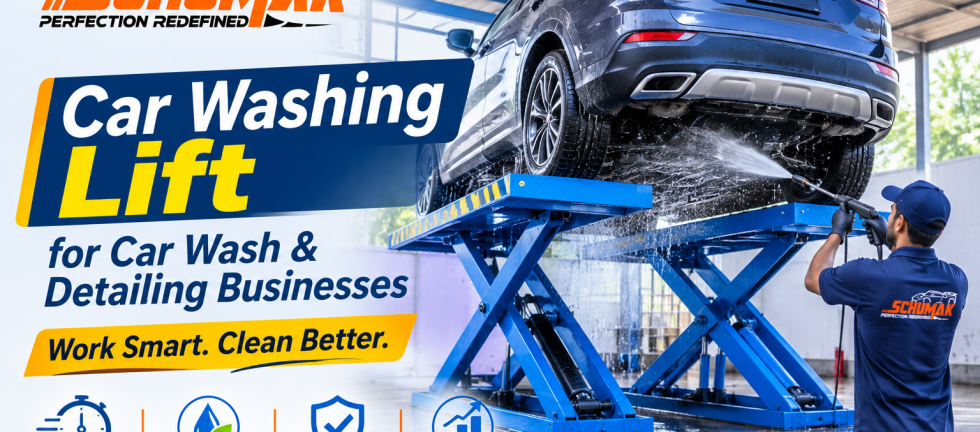
Anyone who has washed a car from the ground knows the routine: crouch down, stretch, move sideways and still miss parts of the underbody. By the car your back is hurting and the quality of your work starts to drop. A car washing lift solves this problem by raising the vehicle to a working height so workers can reach, see and clean properly. This guide explains how a lift fits into the routine of a car wash or detailing business, which setups are best for which shops and what to think about before you buy.
What Is a Hydraulic Washing Lift?
A hydraulic car washing lift is a platform that is lifted by a pump and cylinder. It lifts a vehicle off the ground giving workers access to the underbody for washing, checking and maintenance. It holds the vehicle at a chosen height. Lowers it smoothly when the job is done.
Here’s how it works. The operator opens a control valve pressurized fluid extends the cylinder and the platform rises. Releasing the valve keeps the height steady. Reversing the flow lowers it. Schumak’s guide says these lifts usually raise a vehicle between 600 mm and 1,800 mm and that most units have safety locks at set heights. Unlike a ramp a hydraulic lift offers height control on a stable platform.
Why a Car Washing Lift Matters for Car Wash and Detailing Businesses
Because it lets you do the part of the job properly instead of working around the limits of flat ground.
Schumak’s guide says that full underbody cleaning is not possible on ground. A lift also reduces the tiredness and the stress of positions, which is important during a full day of work.
It can also help you offer services. The guide lists underbody -rust coating, tire rotation and brake inspection, as services that a lift supports. For a business that offers high-quality work a lift is not an extra tool but a working tool.
How a Lift Changes the Daily Workflow
General advice, based on how lifts are usually used.
- Reach: the whole underbody and wheel arches are easy to reach.
- Visibility: workers can see what they are cleaning. Fewer spots get missed.
- Posture: working at a height means less bending and less tiredness.
- Consistency: every car gets the underbody routine no matter who is working.
- Finishing work: with the car raised, detailers can. Finish lower areas more easily.
None of this replaces good technique. It just removes the physical obstacles that make good technique hard to repeat.
Car Wash vs Detailing Studio: Which Setup Fits
General guidance. Every shop is different.
| Need | Car wash | Detailing studio |
| Main focus | Repeatable underbody rinse for every vehicle | Access and finishing quality on each vehicle |
| Lift format | Scissor or underbody lift, as per Schumak’s guide | Scissor or column lift, depending on space |
| Also plan for | Drainage and wash equipment | Lighting and room to work around the vehicle |
Types of Lifts a Wash Business Might Consider
Schumak’s guide describes three common formats:
- Scissor-type lifts: this is the common type used by car wash businesses. They can fold flat when they are not being used. This is good for drive-through lanes where there is no pit space. The weight capacity is usually between 2 and 4 tons.
- Column or post lifts: these have two-post and four-post designs. They provide stability for heavier vehicles. They are suitable for service centres that do both washing and work. The open floor design allows technicians to move freely underneath.
- Washing lifts: this is a type of scissor lift. It has spray nozzle channels built into it. There are also drainage gutters. The water jets go through the platform structure.
Start with your bay layout and the vehicles you serve. The right washing lift is the one that matches both.
Planning Your Wash Bay
Before buying a car washing lift, measure the bay and check the basics.
- Installation: most scissor-type lifts are surface-mounted with anchor bolts, so no pit excavation is required, according to the guide.
- Floor, space and drainage: confirm your floor strength, available space and drainage slope with the manufacturer’s installation team. Column lifts typically need a larger footprint and more ceiling clearance.
- Capacity: the guide recommends a 4-ton rating for headroom, and notes that modern SUVs and MUVs typically weigh 1.8 to 2.8 tons.
- Support documents: ask for an installation kit, anchor bolt specifications and a commissioning checklist.
The guide’s equipment checklist for a service station also includes a high-pressure washer compatible with the lift’s drainage, a water recycling unit, a foam applicator cannon and detergent dosing pump, an air compressor, an underbody coating applicator and a digital job card or POS system.
Safety and Maintenance Basics
General guidance. Always follow the manufacturer’s manual and your local workplace safety requirements.
Schumak’s guide lists mechanical safety locks, an overload protection valve, an emergency manual lowering valve and anti-skid pads as features to look for. Use them: engage the locks before anyone works underneath, and never exceed the rated load.
Do a quick visual check for leaks and platform condition before each shift, and follow the manual for fluid changes and seal replacement. The guide also suggests asking whether spare cylinders and seals are stocked locally, since waiting on parts means downtime. For wider guidance, visit the Ministry of Labour and Employment, and check which standards apply with the Bureau of Indian Standards.
About Schumak India
I discovered that Schumak Equipments (I) Pvt Ltd is located in Coimbatore, Tamil Nadu. On the Schumak Equipments (I) Pvt Ltd website you will find car washing lifts listed as garage equipment. The Schumak Equipments (I) Pvt Ltd blog offers guides for garage and car wash owners.
The Schumak Equipments (I) Pvt Ltd guides cover lift types, load capacity, safety mechanisms, installation. Provide a list of questions to ask a supplier. These questions include whether you can visit the factory, what the lead time is, whether operator training is provided and how the annual maintenance contract works. I suggest you visit the Schumak India website or call +91-93631 44383 for information.
Frequently Asked Questions
Do I need a car washing lift for a small detailing shop?
It depends on your services and volume. A lift gives full underbody access and reduces awkward working postures, and Schumak’s guide says it supports upsell services like underbody coating. If you handle many vehicles, it’s worth considering.
What capacity should I choose?
Schumak’s guide recommends a 4-ton rating, since modern SUVs and MUVs typically weigh between 1.8 and 2.8 tons. That leaves headroom for larger vehicles. Check the SWL plate against the vehicles you serve.
Do I need to dig a pit?
Not for most scissor-type lifts, which are surface-mounted with anchor bolts. Confirm your floor, space and drainage with the manufacturer first. Column lifts typically need a larger footprint and higher ceiling clearance.
What’s the difference between a washing lift and a standard service lift?
A washing lift is built for water exposure, with corrosion resistance, sealed hydraulic fittings and an integrated drainage channel. A standard service lift may not suit regular wet use, according to Schumak’s guide.
Which lift suits a drive-through lane?
A scissor-type lift is usually the choice, since it folds flat when not in use. The guide says this makes it ideal for lanes where pit space is limited.
Raise the Work, Not the Effort
A good lift saves your team’s backs and your customers’ underbodies. Match the format to your bay, choose a sensible capacity, plan the drainage and equipment, and keep the safety basics routine.
If you’re ready to add a car washing lift to your wash bay or detailing studio, explore the Schumak product page and ask for a quote.