

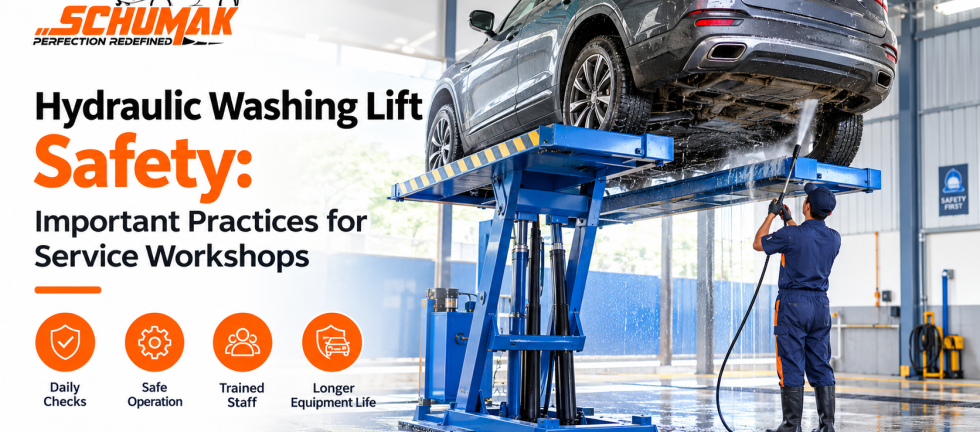
It’s late afternoon, the wash bay is full, and a vehicle is rising on the platform while a technician reaches underneath with a pressure gun. Wet floor, heavy load, tight schedule. That’s an ordinary day in many service workshops, and it’s exactly when shortcuts creep in.
A hydraulic washing lift makes underbody cleaning and inspection faster and easier, but only when it’s used with care. This guide covers the daily checks, operating habits and buying questions that help keep staff and vehicles safe.
What Is a Hydraulic Washing Lift?
A hydraulic washing lift is a platform that is powered by hydraulics. It lifts a vehicle off the ground so that technicians can get to the part of the vehicle. They can wash it, check it and do maintenance. A pump and a cylinder are used to do the lifting. Most of these lifts also have locks.
When the person in charge opens the control valve, the fluid that is, under pressure moves the cylinder. This makes the platform go up. When the valve is closed the platform stays at the height. When the fluid flow is reversed the platform goes down. According to Schumak’s buying guide these lifts usually raise a vehicle between 600 mm and 1,800 mm. The guide also says that most units have safety locks. These locks are activated at heights.
Common types of these lifts are scissor lifts, two-post lifts, four-post column lifts and underbody washing lifts.
Why Safety Matters Around a Hydraulic Washing Lift
Because you’re combining a heavy load overhead with water, detergent and people working close by.
A lift eases fatigue and avoids awkward postures, which is a true safety advantage.. A lift also creates a new danger: a vehicle that is kept high above head level. Wet soapy floors worsen footing. When a job is rushed locks may be ignored and loads can be misjudged.
Safe use of a lift comes down to habits repeated every shift. Always follow the lift manufacturer’s manual and your local workplace safety rules. For wider guidance, you can look at the Directorate General Factory Advice Service and Labour Institutes.
Before You Lift: Daily Safety Checks
General guidance. Always follow your lift’s manual.
- Clear the area: Keep the floor drained, and remove tools, hoses and bystanders from the lift zone.
- Check the platform: It should be clean, and anti-skid pads should be intact.
- Inspect for leaks: Look at hoses, fittings and the cylinder for oil seepage.
- Check the oil level: Use the fluid type your manual specifies.
- Test the controls: The control valve and the emergency manual lowering valve should work smoothly.
- Confirm the locks: Mechanical safety locks should engage and release as designed.
- Read the SWL plate: Make sure the plate is legible and the vehicle is within its rated load.
- Check the base: Anchor bolts should be tight and the base secure.
- Run an empty test: Raise and lower the platform without a vehicle, watching for noise or jerky movement.
Safe Loading and Operating Practices
- Position the vehicle carefully: Drive on slowly and center it on the platform.
- Know the weight: Schumak’s guide notes that modern SUVs and MUVs typically weigh 1.8 to 2.8 tons, so check your vehicle against the lift’s rated capacity, including anything inside it.
- Pause low: Raise the vehicle a short way first and check that it sits stable.
- Keep people clear: Nobody should stand under or beside the platform while it moves.
- Mind the floor: Wet floors and soap cause slips, so keep the area drained and use anti-slip footwear.
- Engage the locks: Make sure the safety lock is engaged before anyone works underneath.
- Lower fully: Bring the platform all the way down before moving the vehicle.
- Train operators: Only trained staff should run the lift.
Common Hazards and Mistakes
- Overloading: Exceeding the rated capacity strains the lift. Never bypass an overload protection valve.
- Skipping the locks: A hydraulic system alone shouldn’t be the only thing holding a vehicle.
- Ignoring small leaks: A weeping seal is a warning, so fix it promptly.
- Wrong lift for the job: A washing lift is built for water exposure, with corrosion resistance and sealed fittings. Schumak’s guide says a standard service lift may not suit regular wet use.
- Rushing: Busy periods are when checks get dropped, so schedule them as part of the routine.
Maintenance and Inspection Schedule
General guidance. Your manufacturer’s manual takes priority.
| When | What to do |
| Daily | Visual check for leaks, platform condition, locks and controls |
| Weekly | Check oil level, hose and fitting condition, anchor bolts and anti-skid pads |
| Periodic | Change hydraulic fluid and replace seals at the intervals in the manual, and have a qualified technician inspect the lift |
Schumak’s guide suggests asking whether the supplier stocks spare hydraulic cylinders and seals locally. Waiting on imported parts means downtime, and downtime tempts people to keep using a worn lift.
How to Choose a Hydraulic Washing Lift With Safety in Mind: Buying Guide
Safety starts at the purchase. Here’s what Schumak’s guide tells buyers to check:
- Load capacity: The guide recommends a 4-ton rating for headroom with larger vehicles. Check the SWL plate and the manufacturer’s certification documents.
- Safety mechanisms: Look for mechanical locks at height increments, an overload protection valve, an emergency manual lowering valve and anti-skid pads.
- Installation support: Ask for an installation kit, anchor bolt specifications and a commissioning checklist.
- Documentation: The manual should state the fluid type, change intervals and seal replacement schedule.
- Certification: Look for ISO 9001:2015 certification for the manufacturing facility, and ask for test certificates for each unit.
- After-sales support: Ask about operator training at your site, response time for breakdowns and the AMC (Annual Maintenance Contract) structure.
- Visit if you can: Ask whether you can see the manufacturing facility before ordering.
You can compare options on Schumak’s hydraulic car washing lift page.
About Schumak Equipment (I) Pvt Ltd
Schumak Equipments (I) Pvt Ltd is based in Coimbatore, Tamil Nadu, and lists hydraulic car washing lifts among the garage equipment on its website. Its blog publishes practical buying guides for garage and car wash owners, covering lift types, load capacity, safety features and how to choose a manufacturer.
Those guides reflect the points above: match the lift to the vehicle, insist on proper safety mechanisms, and choose a supplier who offers installation support, documentation and spares close by. You can explore the products on the Schumak India website or call +91-93631 44383.
Frequently Asked Questions
What is a hydraulic washing lift?
It’s a hydraulically operated platform that raises a vehicle so technicians can access the underbody for washing, inspection and maintenance. A pump and cylinder do the lifting, and most units include mechanical locks that hold the height.
How often should a hydraulic washing lift be inspected?
Do a quick visual check before every shift, looking for leaks, platform condition, locks and controls. Beyond that, follow the schedule in your manufacturer’s manual for fluid changes, seal replacement and professional servicing.
What capacity do I need for SUVs?
Schumak’s guide recommends a 4-ton rated lift, since modern SUVs and MUVs typically weigh 1.8 to 2.8 tons. That leaves headroom for larger vehicles. Always check your lift’s SWL plate against the vehicle.
Can I use a standard service lift for washing?
It isn’t recommended. A washing lift is built for water, with corrosion resistance and sealed fittings, while a standard service lift may not be, according to Schumak’s guide.
Do I need to dig a pit to install one?
Not for most scissor-type lifts, which are designed for surface mounting with anchor bolts. Confirm the floor, space and drainage with the manufacturer before you buy.
Safe Habits Pay Off
A lift is only as safe as the habits around it. Check it daily, respect the rated capacity, engage the locks and keep the floor clear. Choose equipment with proper safety mechanisms and a supplier who stands behind it.
If you’re ready to invest in a hydraulic washing lift, explore the Schumak hydraulic car washing lift page and ask for a quote.