

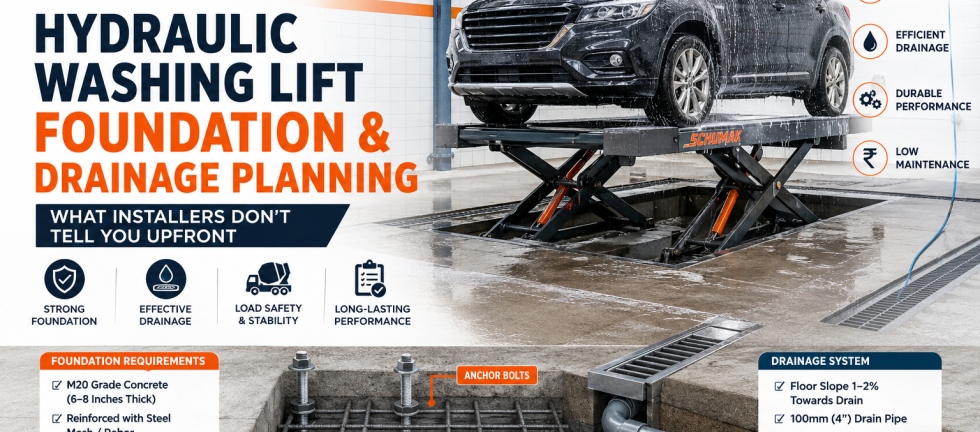
Choosing the right hydraulic washing lift is just the start. Most buyers miss one critical part: foundation and drainage planning. This oversight can lead to unsafe installations, waterlogging, and costly repairs. In this guide, we reveal what installers often skip so you can plan smarter and build safer.
Why Foundation Planning Matters for Hydraulic Washing Lifts
A strong foundation ensures your hydraulic washing lift performs safely and lasts longer. Many garage owners assume any concrete floor will work. That’s a mistake.
Hydraulic lifts place heavy dynamic loads on the floor. Without proper support, the structure can shift, tilt, or even fail. Schumak India recommends a minimum M20 grade concrete slab for all surface-mounted lifts.
Key reasons to plan your foundation carefully:
- Prevents uneven settling
- Supports safe load distribution
- Reduces vibration and noise
- Extends equipment lifespan
Always consult your manufacturer before pouring concrete or anchor bolts.
Drainage Planning: The Hidden Challenge in Car Wash Bays
Water is essential for car washing-but it can damage your lift if not managed well. Poor drainage leads to:
- Water pooling under the lift
- Rust and corrosion on metal parts
- Slip hazards for staff
- Damage to hydraulic components
A well-designed drainage system channels water away quickly and safely. Schumak’s hydraulic washing lifts are built to work with open drains or floor gutters.
Best Practices for Drainage Around Your Lift
- Slope the floor at least 1–2% toward the drain
- Use a minimum 4-inch (100mm) drain pipe
- Install an air-break to prevent backflow
- Keep drains clear of debris and sludge
Proper drainage protects your investment and keeps your workspace safe.
Foundation Requirements You Must Know
Not all floors are ready for a hydraulic washing lift. Here’s what your foundation must include:
1. Concrete Grade and Thickness
- Minimum M20 grade concrete
- Slab thickness: 6–8 inches (150–200mm)
- Reinforced with steel mesh or rebar
2. Anchor Bolt Specifications
- Use manufacturer-provided anchor bolt patterns
- Ensure bolts are embedded deep enough for load safety
- Avoid drilling near edges or weak spots
3. Level Surface
- Floor must be flat within ±3mm over 2 meters
- Uneven floors cause lift instability and wear
4. Load-Bearing Capacity
- Must support at least 4 tons for SUVs and light commercial vehicles
- Verify with a structural engineer if unsure
Drainage System Design for Car Wash Lifts
Your drainage system must handle high water volume and detergent flow. Here’s how to design it right:
1. Drain Placement
- Position drains at the lowest point of the wash bay
- Keep them away from lift anchor points
- Use covered grates to prevent debris entry
2. Pipe Sizing and Slope
- Minimum 100mm (4-inch) diameter PVC or HDPE pipe
- Slope: 1–2% for gravity flow
- Avoid sharp bends-use long-sweep elbows
3. Water Recycling and Disposal
- Install oil-water separators if required by law
- Connect to municipal drainage or soak pits
- Consider water recycling units to reduce costs
Common Mistakes Installers Make (And How to Avoid Them)
Even experienced installers can miss key details. Here are the top errors—and how to prevent them:
Mistake 1: Ignoring Soil Conditions
Soft or loose soil can cause foundation sinking. Always test soil bearing capacity before construction.
Mistake 2: Skipping Waterproofing
Water seepage weakens concrete over time. Use waterproofing membranes under the slab.
Mistake 3: Poor Drain Slope
Flat floors trap water. Ensure at least 1% slope toward drains.
Mistake 4: Using Weak Concrete
M15 grade concrete may crack under heavy loads. Stick to M20 or higher.free.bcpublications+2
How Schumak India Supports Proper Installation
As a leading hydraulic washing lift manufacturer in India, Schumak provides full installation support. Our team helps you with:
- Site inspection and layout planning
- Foundation and drainage design advice
- Anchor bolt templates and load charts
- On-site commissioning and operator training
We’ve installed hundreds of lifts across India-with zero safety incidents. Our ISO 9001 certification and 25+ years of experience ensure you get reliable, long-lasting equipment.schumakindia+1
Checklist Before You Install Your Hydraulic Washing Lift
Use this quick checklist to avoid costly mistakes:
- Confirm floor concrete grade (M20 minimum)
- Check slab thickness (6–8 inches)
- Verify load-bearing capacity (4+ tons)
- Plan drain location and slope (1–2%)
- Install oil-water separator if needed
- Use manufacturer anchor bolt template
- Schedule pre-installation site visit with Schumak team
Build Smart, Wash Safe
A hydraulic washing lift is a major investment. Don’t let poor foundation or drainage planning ruin it. Follow expert guidelines, consult your manufacturer, and build a safe, efficient car wash bay.
At Schumak India, we’re here to help you every step of the way-from planning to installation and beyond.
Ready to upgrade your car wash station? Contact Schumak India today for a free site consultation and lift recommendation.