

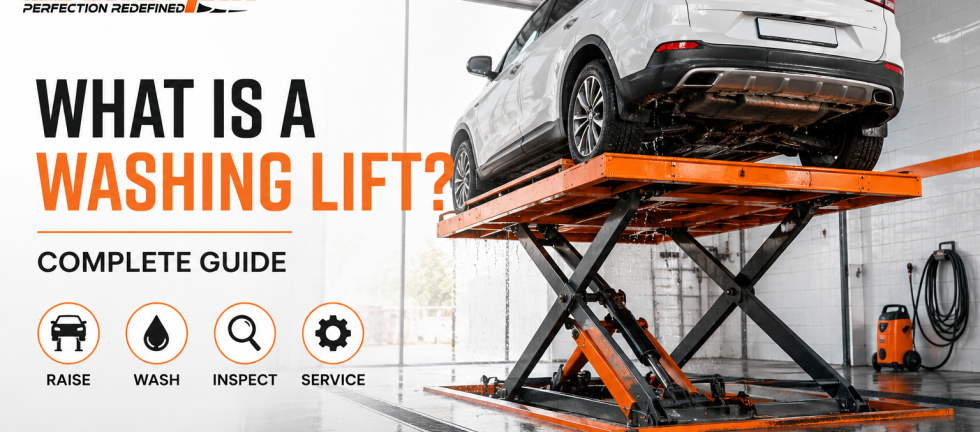
A washing lift refers to a hydraulic device that allows mechanics to lift a vehicle from the ground making it possible for professionals to wash, inspect, and repair its components from below without having to get underneath the vehicle. If you’re planning to open a car wash location, repair garage, or fleet service center, you’ll need to consider purchasing a washing lift as it has a direct impact on the total number of vehicles serviced per day as well as the efficiency of your workers in general.
This article explains the concept of a washing lift, its operation, types of washing lifts available in the market today, and the differences between it and a conventional vehicle lift.
What Is a Washing Lift?
Fundamentally, a washing lift is specifically engineered for the wash bay environment. It is not like a general workshop lift as it is designed to withstand continuous exposure to water, detergent and dirt while still lifting the vehicle to a suitable, variable working height ranging generally from 600 mm to 1800 mm above the ground.
These units are manufactured in different load capacities to suit different vehicles. Schumak, for example, produces washing lifts ranging from 1 ton for two wheelers up to 25 tons for buses and heavy commercial vehicles, all manufactured at a CE and ISO 9001:2015 certified facility in Coimbatore, Tamil Nadu.
How a Washing Lift Works
The system operates on a hydraulic pump and cylinder system. The operator activates the controls, allowing the pressurized hydraulic fluid to propel the piston in an upward motion. Once the control is released the unit is secured in place by using a mechanical lock which is engaged at pre-defined stages of heights.
After the cleaning, oiling, or underbody inspection is finished, the reversal of hydraulic fluid allows for the lowering of the platform in a controlled manner. Such a simple design of the system explains why it requires little maintenance compared to complicated systems and why it can operate frequently in a busy wash bay without wearing out easily.
Types of Washing Lifts
Not all vehicle lifts are created equally. Your garage configuration, the kinds of vehicles you intend to lift and your daily lifting routine will all dictate the right type of vehicle lift for your use.
Scissor Type
Scissor lifts are advantageous in the situation where the dimensions of the wash bay limit available equipment space. Scissor lifts provide the perfect solution in the case of cars and lightweight commercial vehicles that need a quick and effective lifting process.
Single Post Type
A single post type vehicle lift consists of a single post and a single hydraulic cylinder. Such device is very convenient in terms of maintenance and installation. Single post lifts are suitable for general vehicle washing and lubrication where it is more or less sufficient to have a single point of lift support.
Twin Post Type
With the more massive vehicles like trucks and buses, it is advisable to choose the twin post design to enhance the stability of the lifting system as well as the distribution of weight across two lift points. It is well-known that this design is used with increased carrying capacity because the heavy vehicle requires more support while lifting.
Regardless of type, most models can also be fitted with additional attachments such as a tyre rest platform or spider arms, which support the vehicle’s wheels directly and help prevent the underside of low clearance vehicles from touching the platform frame.
Washing Lift vs a Standard Car or Service Lift
It is easy to assume any vehicle lift can double as a washing lift, but the two are built for different jobs.
| Feature | Washing Lift | Standard Service Lift |
| Water and drainage handling | Designed for constant water exposure, wiper rings prevent water and dirt entering the hoist cylinder | Not built for continuous water exposure |
| Platform design | Open platform suited to washing and underbody access | Often solid or arm based, built for mechanical work |
| Typical use | Car wash bays, washing and lubrication | General repair, tyre change, mechanical servicing |
| Installation | Surface mounted, no pit required | Varies, some require in ground installation |
A standard service lift is engineered for mechanical work like brake changes or tyre replacement, where water exposure is occasional rather than constant. This equipment, on the other hand, is engineered from the ground up for a wash bay, with sealed components and wiper rings that keep water and dirt out of the hydraulic cylinder during repeated daily use. If your business runs a high volume wash operation, a purpose built model will hold up far better over time than a general purpose lift pressed into washing duty.
Common Uses and Applications of a Washing Lift
This equipment is used wherever a vehicle needs to be raised for cleaning, inspection or light servicing. Typical applications include:
- Washing and lubrication of passenger vehicles at car wash centers
- Underbody washing and rust proofing for commercial fleets
- Two wheeler washing at bike service and wash stations
- Bus and truck washing at commercial vehicle wash facilities
- Underbody inspection as part of routine service checks
Since it conforms to the working height of the technician instead of utilizing a stable structure like a ramp or pit, it helps in minimizing the strain on the workers who would otherwise have to squat down or bend over to reach the lower side of a vehicle.
Key Features to Look for in a Washing Lift
Before buying one, it is worth checking a few things beyond just the price tag.
Certification. Look for CE certification, which ties back to the EN 1493 safety standard for vehicle lifts, along with ISO 9001:2015 manufacturing certification. These are not just paperwork, they indicate the equipment has been built and tested to a recognized safety benchmark.
Load capacity. Match the rated capacity to the heaviest vehicle you expect to service, not just your average vehicle, and always check the Safe Working Load plate against the manufacturer’s documentation.
Safety locks. The platform should include mechanical safety locks at multiple height increments, along with overload protection, so it cannot descend unexpectedly.
Build quality. Details like hard chrome plated plungers, gland rings, and wiper ring seals affect how long the equipment lasts under constant water and dirt exposure, so it is worth asking a manufacturer directly about these components rather than assuming they are standard.
Installation requirements. Most units are surface mounted with anchor bolts and do not require pit excavation, which keeps installation faster and less disruptive than in ground alternatives.
Frequently Asked Questions
What is a washing lift used for? It raises a vehicle to a safe working height so technicians can wash, inspect or lubricate the underbody without a pit or ramp.
How high can a washing lift raise a vehicle? Most units raise vehicles between 600 mm and 1800 mm, depending on the model and configuration, giving technicians full standing access underneath.
Is a washing lift the same as a car lift? Not exactly. It is purpose built for constant water exposure with sealed components and wiper rings, while a standard car lift is generally built for mechanical servicing rather than washing.
Do washing lifts need a pit for installation? No. Most hydraulic models are installed on the surface using anchor bolts, which means no excavation or major civil work is needed.
What capacities do washing lifts come in? They are typically available from 1 ton for two wheelers up to 25 tons for buses and heavy commercial vehicles, so the right capacity depends on the vehicles your business services.
Final Thoughts
A washing lift is a purpose built piece of equipment that keeps a wash bay running safely and efficiently, whether you are washing hatchbacks or heavy commercial trucks. Understanding the type, capacity and certification that fits your business is the first real step before comparing manufacturers or requesting a quote.
Once you know your bay layout and vehicle mix, the next step is comparing specific models against your daily throughput needs, and a certified manufacturer should be able to walk you through that comparison directly.