

Consult any proprietor of a detailing store on what causes him sleepless nights, and he will invariably tell you that it is not the clients, nor is it the competitive aspect of the business, but the struggle to find and maintain a steady workforce of washers.
Detailing a car for many hours a day, cleaning dirt from hard-to-reach spots of the vehicle is arduous work. It is obvious now why turnover in this business is extremely high, money spent on training skyrockets every time a person exits, and business owners are forced to handle the labor on their own.
A car washing lift changes that equation entirely, and more Indian detailing businesses including a growing number in Coimbatore are discovering it isn’t a luxury upgrade anymore. It’s becoming the difference between a shop that scales and one that stays stuck hiring the same role every three months.
The Labor Shortage Crisis in the Detailing Industry
In recent years, the industry of auto detailing and washing has turned out to be one of the hardest to manage in big cities in India. Even though workers in introductory positions have started to make more money in recent years, the situation with retaining personnel does not improve, as the fundamental issue has always been the difficult nature of the job itself.
After having talked to car repair equipment suppliers and franchise firm owners, one can see that the trend is revealing patterns across dealerships: inexperienced workers come for a certain time and leave for new employment, when they get an offer from a partner.
A few forces are compounding this:
- Rising urban wage expectations without a matching rise in job appeal
- Alternative gig-economy jobs (delivery, ride-hailing) that offer similar pay with less physical strain
- Detailing businesses expanding faster than the skilled-labor pool feeding them
- Owners reluctant to invest in training staff who may leave within months
None of this means the demand for car care is slowing down if anything, it’s growing. What’s changing is who, or what, is doing the physical work. This is exactly where elevated wash equipment starts to matter.
Why Manual Car Washing Is Physically Unsustainable at Scale
Anyone who has actually washed cars for a living knows the job isn’t glamorous. A worker crouches to clean rims, kneels to reach the underbody, stretches across a bonnet, and repeats that cycle dozens of times a day. Over months, that repetitive strain adds up to real injuries: lower back pain, knee problems, shoulder wear and those injuries are a quiet but major driver of attrition.
There’s also a throughput problem. Ground-level washing is slow by nature. It’s true that the worker is limited in terms of how fast they can wash a car if they’re constantly changing positions, getting in and out of tight spots like the wheel arches or the chassis usually leads to very poor work quality. This inconsistency can show up in customer complaints about repeat visits, which are something that any business wants to avoid given the competitive nature of the industry.
In busy periods like a busy weekend rush with ten or twenty or thirty vehicles, it simply doesn’t work anymore. That means that either they need to hire more people to solve the problem of manual washing being time-consuming and accident-prone, or the quality of washer’s work decreases significantly as the staff rushes from one car to another.
How Car Washing Lifts Change the Equation
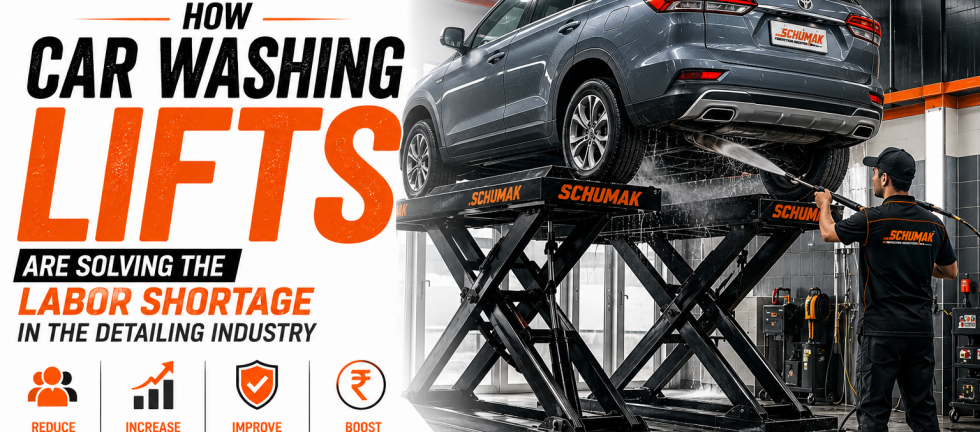
Such lifts take care of the main problem as they let workers completely avoid having to bend, squat, or crawl. They lift the vehicle to a level where it is possible for a single operator to maneuver around the vehicle, wash undercarriage, wheels, and chassis, and do all the work without having to make any efforts. A Car Washing Lift makes this elevated working position possible while keeping the washing process more practical.
The practical impact on labor is significant:
- One trained operator can do what previously took two or three workers, since elevation removes the slow, repositioning-heavy parts of the job
- Injury risk drops sharply, which directly improves retention workers stay longer in roles that don’t wreck their backs
- Training time shortens, because operating a lift-assisted wash bay is more standardized and less dependent on individual physical stamina
- Throughput increases, letting shops handle more vehicles per shift without proportionally increasing headcount
This isn’t about replacing people with machines; the lift still needs a skilled operator. What it does is make that one operator dramatically more productive and far less likely to burn out or get injured on the job. For an industry where the labor pool is thin and turnover is constant, that shift in productivity per worker is the real solution to the shortage, not just a nice efficiency gain.
There’s a case-study pattern that plays out again and again in shops that switch: a Coimbatore-based detailing outlet owner recently described struggling with three washers who kept rotating out every few months, each departure costing weeks of lost productivity while a replacement got up to speed.
After installing a hydraulic lift system, the same shop ran with two operators instead of three, cut average wash time nearly in half, and perhaps most tellingly kept both operators on staff well past the point where previous hires had typically quit.
Car Washing Lift in Coimbatore – Local Demand & Availability
The automotive service and detailing industry in Coimbatore has grown quickly, going hand in hand with the growing rate of vehicle ownership and the capability of Coimbatore to be known as a hub of manufacturing and engineering. Numerous new detailing centers, franchised car wash chains, and individual garages have opened up all around Coimbatore and its industrial corridors, and it seems that they all ran into the same staffing difficulty discussed above. For these businesses, investing in a Car Washing Lift can provide a more efficient way to handle vehicle washing and underbody cleaning.
What’s holding many of these businesses back isn’t demand it’s equipment access and after-sales support. This kind of investment is a mechanical commitment, and shop owners understandably want assurance that if something breaks down, a technician can actually show up and fix it, rather than leaving a bay out of commission for weeks. That’s why local availability of this equipment, backed by real service infrastructure and not just a one-time sale, has become such a deciding factor for operators choosing equipment in the region.
Shops in and around Coimbatore that have made the switch tend to report the same benefits: fewer staffing headaches, faster turnaround during peak hours, and a noticeably lower rate of underbody-related quality complaints, the kind that used to come from rushed, ground-level washing.
The Schumak Equipment Solution
This is where Schumak Equipment (India) Pvt Ltd fits into the picture. Schumak has been manufacturing automotive service equipment since 1999, carrying an ISO 9001 certification and more than two and a half decades of experience building garage equipment for OEM workshops and private garages alike. That kind of track record matters in an industry where buyers are wary of equipment that looks good on a brochure but fails under daily commercial use.
For a detailing shop wrestling with the labor problem outlined above, Schumak’s approach addresses it from two angles:
- Durable, ergonomically designed car washing lifts that are straightforward enough for a newly trained operator to run confidently within days, not weeks directly cutting the training burden that comes with high staff turnover.
- A dealer and field-support network spread across India, meaning a shop investing in this equipment isn’t left stranded if something needs servicing. Schumak’s engineering and field teams are built specifically to back up equipment after the sale, which is often the deciding factor for operators who’ve been burned by cheaper, unsupported machines before.
For a Coimbatore shop owner specifically, that combination quality manufacturing plus accessible local support is what turns this equipment from a nice-to-have into a dependable long-term fix for the staffing problem, rather than just another piece of equipment gathering dust after the warranty runs out.
What to Look for When Buying a Car Washing Lift
Not every lift on the market is built for commercial detailing use. Before buying, shop owners should weigh:
- Load capacity – Confirm it comfortably handles the heaviest vehicles you service, including SUVs and light commercial vehicles, with margin to spare
- Hydraulic vs. electric operation – Hydraulic lifts tend to suit high-frequency commercial bays, while electric models can suit lower-volume setups; the right choice depends on daily vehicle count
- Safety certifications – Look for ISO-certified manufacturers and built-in safety locks, since a lift is a load-bearing piece of equipment used dozens of times a day
- Local service availability – A lift is only as good as the support behind it; confirm a dealer or technician can respond quickly if something goes wrong
- Warranty and spare parts access – Ask specifically how long parts remain available, not just how long the warranty lasts
Skipping this checklist is how shops end up with equipment that looks fine on day one and becomes a liability six months in.
Frequently Asked Questions
What is a car washing lift? A car washing lift is a hydraulic or electric platform that raises a vehicle to a comfortable working height, allowing operators to wash the underbody, wheels, and chassis while standing upright instead of bending or crawling underneath.
How much does a car washing lift cost in India? Pricing varies by load capacity, lift mechanism (hydraulic vs. electric), and brand, so shop owners should request a direct quote based on their vehicle types and daily volume rather than relying on a fixed figure.
Is a car washing lift good for small detailing shops? Yes. Even small shops benefit because a single operator can wash vehicles faster and more thoroughly, reducing the need to hire multiple washers and easing the pressure of constant staff turnover.
Does a car washing lift really help with staff retention? Indirectly, yes — by removing the repetitive bending and crouching that causes injury and fatigue, lift-assisted washing makes the job less physically punishing, which tends to keep workers in the role longer.
Final Thoughts
The labor shortage in the detailing industry isn’t going away on its own, and hiring harder isn’t a real fix when the job itself is the problem. The right lift addresses the root cause — the physical strain that drives workers out while also making each remaining employee dramatically more productive. A Car Washing Lift can help shops improve working conditions while increasing productivity in the wash bay.
For shops in Coimbatore and across Tamil Nadu weighing this investment, working with an established, ISO-certified manufacturer like Schumak Equipment means getting not just a machine, but the local support to keep it running for years. If staffing has been your shop’s biggest headache, it may be time to look at schumakindia.in and see what the right equipment can actually do for your bay.