

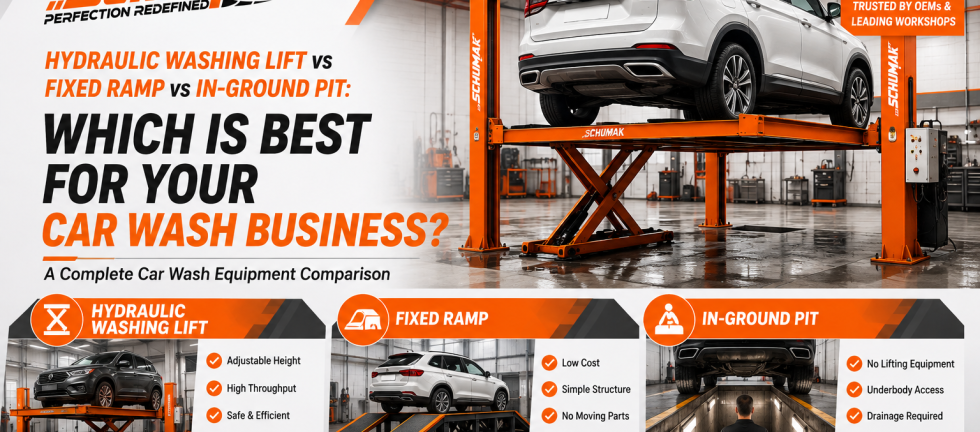
Choosing underbody access equipment is one of the first decisions that shapes how your car wash actually runs day to day. A hydraulic washing lift, a fixed ramp, and an in-ground pit all solve the same basic problem of getting underneath a vehicle for washing, inspection, or servicing but they solve it in very different ways, with very different cost, space, and safety implications. This car wash equipment comparison walks through all three, honestly, so you can match the right option to your actual bay layout and throughput needs.
The Three Underbody Access Options, Explained
Before comparing cost and throughput, it helps to understand how each option actually works. The mechanics behind each one explain most of their trade-offs.
Hydraulic washing lift
A hydraulic washing lift raises a vehicle using a pump-and-cylinder system: hydraulic fluid is pressed into a cylinder, driving a rod upward that lifts the platform to the required working height. The operator controls height precisely, and the vehicle stays stable at whatever level is needed for washing, inspection, or rust-proofing. Because the lift mechanism does the work, a washing lift doesn’t depend on a fixed incline or excavated space — it adapts to the bay it’s installed in.
Fixed ramp
A fixed ramp is exactly what it sounds like: a stationary inclined structure that a vehicle drives up under its own power. There’s no lifting mechanism and no moving parts to maintain — the vehicle’s height above the floor is fixed by the ramp’s design and can’t be adjusted per vehicle. This simplicity is the ramp’s main appeal, but it’s also its main limitation.
In-ground service pit
A service pit is a below-grade excavated trench that a vehicle drives over, allowing a technician to walk underneath at floor level rather than raising the vehicle at all. It requires no lifting equipment, but it does require permanent civil work — excavation, structural lining, and typically drainage provisions to manage water runoff during washing.
Comparison Table: Cost, Space, Safety, Throughput
Here’s how the three options stack up on the factors that matter most for a car wash business:
| Criteria | Hydraulic Washing Lift | Fixed Ramp | In-Ground Pit |
| Upfront Cost | Moderate — equipment cost, but installation is straightforward | Low — simplest structure, minimal installation | Moderate to high — excavation and civil work add significant cost |
| Space/Civil Work Required | Minimal — anchor-bolt mounting, no excavation, fits into an existing bay | Minimal — needs floor space for the ramp footprint, no excavation | Extensive — requires excavation, drainage, and structural work before use |
| Safety Considerations | Controlled hydraulic operation, stable locked height, reduced manual strain | Generally safe but offers no height adjustment for different vehicle types | Confined-space risk for technicians working below grade; drainage/flooding risk if not properly managed |
| Throughput (cars/day, single bay) | 30–50 cars/day | Lower — limited by manual positioning and fixed height | Lower — technician movement in a confined space slows cycle time |
| Maintenance | Periodic hydraulic seal/fluid checks | Minimal — few moving parts | Ongoing drainage and structural upkeep |
When a Ramp Still Makes Sense
A fixed ramp isn’t obsolete — it’s genuinely the right call in specific situations. If your operation runs on a very tight budget and handles a narrow range of vehicle types with similar ground clearance, a ramp’s simplicity and low cost can outweigh the lack of height flexibility.
Ramps also make sense for low-throughput operations where washing isn’t the primary revenue driver, or as a temporary solution while a business is still establishing its facility. What a ramp can’t do well is adapt to a wide mix of vehicle heights or scale up throughput as demand grows — that’s usually where operators start looking at alternatives.
When a Pit Makes Sense (and Its Drawbacks)
A service pit makes the most sense when a facility already has one built — ripping out existing pit infrastructure to install a lift rarely pencils out financially if the pit is functional and the space works for current operations. Pits also don’t require lifting equipment at all, which can appeal to operations wary of hydraulic maintenance.
That said, the drawbacks are real. Excavation and structural work make pits expensive and slow to install from scratch. Drainage becomes a genuine engineering concern in a wash environment, where water and detergent runoff need somewhere to go — poor drainage design leads to standing water and flooding risk over time.
Technicians working in a below-grade, confined space also face different safety considerations than someone operating a lift at a controlled, visible height. And once built, a pit is difficult and costly to modify if your vehicle mix or bay layout changes later.
Why Most Modern Car Washes Choose Hydraulic Lifts
The throughput difference is the clearest business case: a hydraulic washing lift supports washing 30 to 50 cars a day in a single bay, a level that fixed ramps and pits typically can’t match due to slower positioning and manual movement constraints. That throughput advantage compounds over a full operating day.
Installation is the other major factor. Unlike a service pit, a hydraulic washing lift is installed using anchor-bolt mounting and does not require excavation or major civil work — most garages can fit a lift into an existing bay without the cost and downtime of digging a pit. Lifts also support both indoor and outdoor installation, which gives operators more flexibility in site selection than a pit’s fixed excavation allows.
Height precision matters too. A hydraulic lift lets technicians position a vehicle at the exact working height needed for underbody washing, inspection, or rust-proofing — something a fixed ramp simply can’t offer, since its height is set by the structure itself, not the operator.
Certification is worth understanding here as well: CE marking for vehicle lifts is tied to the European EN 1493 safety standard, and buyers evaluating any lift manufacturer’s certification claims can find more detail on what that verification actually covers through the Automotive Lift Institute’s certification resources. Schumak’s washing lifts are manufactured in a CE and ISO 9001:2015 certified facility in Coimbatore, Tamil Nadu, backed by 25 years of experience serving OEM workshops and private garages since 1999 — with lifts in use by OEM and fleet operators including Maruti Suzuki, Toyota, Mahindra, Hyundai, Tata, and the Indian Army.
If you’re weighing capacity and configuration for your own bay layout, you can explore our hydraulic car washing lift range to compare models from 1 ton up to 25 tons.
FAQs
Is a pit cheaper than a hydraulic washing lift long-term?
Not usually. A pit’s upfront excavation and civil work costs are often higher than a hydraulic lift’s installation cost, and pits typically support lower daily throughput. Over time, a washing lift’s higher car-per-day capacity can offset its equipment cost more effectively than a pit’s lower operating volume.
Do hydraulic lifts require civil work?
No. A hydraulic washing lift is installed using anchor-bolt mounting rather than excavation, allowing most garages to install one into an existing bay without major civil work — unlike an in-ground pit, which requires excavation and structural work before it can be used.
Which option is safest for daily high-volume use?
A hydraulic washing lift generally offers safer high-volume operation than a pit, since technicians work at a controlled, visible height rather than in a below-grade confined space. Lift safety is also governed by recognized standards such as EN 1493, which set design and verification requirements for vehicle lifts.
Can a fixed ramp be upgraded to a hydraulic washing lift later?
Generally, yes, since a ramp doesn’t require the excavation a pit does. Most garages can remove a ramp and install a hydraulic washing lift into the same bay using anchor-bolt mounting, making it a more straightforward upgrade path than converting a pit.
What vehicle types can a hydraulic washing lift handle?
Hydraulic washing lifts are available across a wide capacity range, from single-post lifts suited to two-wheelers and hatchbacks up to twin-post configurations rated for buses, trucks, and commercial fleet vehicles — unlike a fixed ramp, which is built around a single vehicle height profile.