

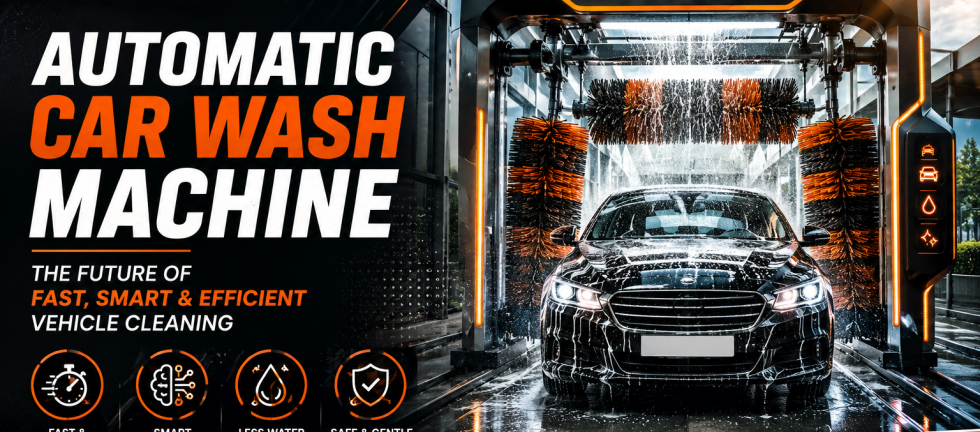
Ask any garage owner what eats up the most time in a day, and there’s a good chance washing cars will come up. It’s repetitive, it needs a steady hand, and it’s one of the first things that suffers when staff call in sick or a queue of cars starts backing up outside. That’s the gap an automatic car wash machine is built to close. Instead of relying on a team of workers with buckets and sponges, the machine takes over the entire cleaning cycle — pre-rinse, soap, scrub, rinse, dry — and does it in a fraction of the time, every single time, without getting tired or cutting corners on a busy Saturday.
If you’re running a wash center, a service station, or a dealership and you’ve been on the fence about automation, this is worth reading properly. We’ll walk through what an automatic car wash machine actually is, how it functions under the hood, what it means for your water bills and your bottom line, and why more entrepreneurs setting up an automatic car wash in Coimbatore are choosing this route over traditional manual bays.
What Is an Automatic Car Wash Machine?
In plain terms, it’s a machine that washes your car for you — no hands, no sponge, no guesswork. The vehicle either rolls through a fixed tunnel-style structure or stays parked in one spot while the machine’s arms, brushes, or jets do all the moving. Sensors read the car’s shape and size, and the system adjusts itself accordingly before the wash even begins.
There are really two schools of thought here. Brush-based systems use soft foam brushes that physically make contact with the car’s surface to lift off dirt — think of it as a very precise, very consistent version of hand-scrubbing. Touchless systems skip the physical contact altogether and rely purely on high-pressure water and chemical action to break grime loose. Touchless has picked up a lot of fans lately, mostly because there’s zero risk of swirl marks on the paint, which matters a great deal to anyone running a premium showroom or dealing with luxury vehicles.
How an Automatic Car Wash Machine Works
No two machines are identical, but most automatic car wash machine setups follow roughly the same rhythm:
- The car pulls in and sensors map out its position and body contour.
- A pre-rinse blasts away loose mud, dust, and surface grit.
- Detergent or foam goes on to loosen up grease and stuck-on grime.
- The wash cycle kicks in — brushes rotating around the car, or touchless jets circling it at set angles and pressure.
- Clean, filtered water rinses off every trace of soap.
- Air blowers or dryer arms finish the job with a streak-free dry.
Start to finish, you’re usually looking at somewhere between three and eight minutes per vehicle. Compare that to the twenty-plus minutes a manual wash crew typically needs, and it’s easy to see why the math starts working in your favor fast.
Why Business Owners Are Actually Switching
There’s no shortage of reasons wash center owners are moving toward automation, but a handful come up again and again in conversations with people running these businesses.
It’s Just Faster
An automatic car wash doesn’t get slower on a busy day the way a tired manual crew does. Every car gets the same cycle, at the same speed, whether it’s the first wash of the morning or the fiftieth.
You’re Not Chasing Staff Around Anymore
Anyone who’s run a wash bay knows the headache of last-minute no-shows and constant staff turnover. Cut down the number of hands you need on the floor, and a lot of that stress simply disappears.
More Cars, More Revenue
Faster cycles mean you can push through a lot more vehicles in the same operating hours. That directly translates into more billing per day without adding a single extra bay.
Customers Notice, Too
There’s something reassuring about watching a modern machine handle your car with precision. It signals a level of professionalism that a lot of customers associate with quality, and that reputation tends to spread by word of mouth.
Your Car’s Paint Job Stays Safer
This one matters especially for touchless setups. No brushes touching the surface means no risk of the fine scratches that come from grit trapped in a sponge or brush — a real selling point for showrooms and anyone handling higher-end vehicles.
The Water-Saving Angle Nobody Talks About Enough
Here’s something that doesn’t get nearly enough attention: automation is genuinely good for water conservation, and that’s becoming a bigger deal as cities tighten restrictions on commercial water use.
- A lot of modern automatic car wash machine models come with built-in water recycling, filtering and reusing water across multiple washes instead of sending it straight down the drain.
- Nozzles are calibrated to release only what’s needed at each stage, unlike a hose left running while someone scrubs — which wastes far more water than people realize.
- Controlled spraying also means less soapy runoff reaching storm drains, which is a small but meaningful environmental win.
Depending on the setup, that can mean using 50 to 70 percent less water per car compared to the old hose-and-bucket approach — a number that matters both for your water bill and for operating responsibly in water-stressed regions.
What This Means for Your Business, Long Term
Speed and water savings aside, there’s a broader business case for investing in a car wash machine that’s worth spelling out.
- Lower running costs over time, once you factor in reduced labor, water, and chemical wastage.
- Room to scale — extend your operating hours or add shifts without a proportional jump in staffing costs.
- A sharper brand image, since a modern automated setup tends to read as more premium than a traditional manual bay.
- More time and floor space for add-ons like detailing, waxing, or interior cleaning, since the core wash takes up so much less time.
- Simpler training — operating a machine takes far less time to teach than proper manual washing technique.
Automatic Car Wash vs. Manual Washing: How They Really Stack Up
It’s a fair question — is automation actually worth the upfront cost, or is manual washing still good enough? Here’s how the two compare on the things that actually matter to a business owner.
Speed
Manual washing usually takes 20 to 30 minutes and depends heavily on how many workers you’ve got on shift. An automatic car wash machine gets it done in under ten minutes, and staffing levels barely factor in.
Cost Over Time
Manual setups are cheaper to start, no argument there. But they carry higher ongoing labor and water costs. Automatic systems ask for more upfront, then repay that investment through lower per-vehicle costs as volume climbs.
Consistency
A manual wash is only as good as the person doing it that day — tired workers cut corners, simple as that. A machine runs the same programmed cycle every time, so quality doesn’t swing from one wash to the next.
Water Use
Manual washing tends to burn through more water because hoses run unregulated. Automatic systems calibrate exactly how much water each stage needs, and often recycle a good chunk of it.
Scaling Up
Growing a manual operation usually means hiring more people, which gets expensive fast. Automated systems scale far more gracefully, handling higher volumes without needing a matching jump in headcount.
For anyone thinking beyond the next six months — dealerships, high-traffic locations, multi-branch plans — an automatic car wash machine tends to be the more sustainable bet.
What This Looks Like for an Automatic Car Wash in Coimbatore
Coimbatore’s automotive and industrial scene has been growing steadily, and with more vehicles on the road, demand for quick, reliable car care has grown right along with it. Entrepreneurs setting up an automatic car wash in Coimbatore are in a strong position to serve dealerships, corporate fleets, and everyday car owners who’d rather not spend half an hour waiting around for a wash.
There’s a practical local advantage too — Coimbatore already has a solid base of automotive equipment manufacturers, which makes installation, spare parts, and after-sales support a lot easier to source than in cities without that kind of ecosystem.
Where the Industry Is Headed Next
Car wash technology isn’t standing still, and a few trends are worth keeping an eye on if you’re planning for the next few years, not just the next few months.
- Smarter, AI-driven sensors that read a vehicle’s size and dirt level and adjust the wash intensity accordingly.
- App-based booking and contactless payments, making the whole experience feel more seamless for customers.
- Biodegradable detergents paired with recycling systems, pushing the water-saving story even further.
- IoT-based monitoring that flags maintenance issues before they turn into a breakdown mid-shift.
- Compact, touchless car wash machine layouts built specifically for tighter urban spaces.
Businesses that get ahead of these shifts now are likely to have a real edge as customers keep raising the bar on speed, cleanliness, and convenience.
Why Schumak India Is Worth a Look
Schumak India builds automotive service equipment meant to actually hold up under daily commercial use — not just perform well on day one. That’s the kind of reliability garage owners and entrepreneurs across the country have come to depend on.
If you’re setting up a new wash center or upgrading an old one, it’s worth taking a look at Schumak India’s touchless car wash machine — built to clean without contact, run efficiently on water, and give customers the kind of experience that keeps them coming back.
Equipment built for real Indian road conditions and real business demands makes the difference between chasing short-term convenience and building something that actually lasts.
Bottom Line
Automation in car care isn’t some passing fad — it’s a direct answer to the pressures every wash center owner deals with: water costs, labor headaches, and customers who expect more, faster. An automatic car wash machine lets you run a tighter, more consistent operation while giving your customers the modern experience they’re increasingly looking for.
Whether you’re starting fresh or upgrading what you’ve already got, it’s a good time to look into Schumak India‘s automatic touchless car wash solutions and take the first real step toward a faster, smarter car wash business.
Frequently Asked Questions
1. What does an automatic car wash machine typically cost in India?
It depends on the type and capacity — basic setups can start in the lower lakhs, while fully automated, high-throughput systems cost considerably more.
2. Touchless or brush-based — which one’s better?
Touchless is generally safer for the paint since nothing physically touches the car, while brush-based systems can handle heavier dirt more aggressively. It really comes down to your typical customer base.
3. How much water do these machines actually save?
With recycling and calibrated spraying, most automatic car wash machines cut water use by roughly 50 to 70 percent per vehicle compared to a manual hose wash.
4. Is starting an automatic car wash in Coimbatore a good business move?
Yes — rising vehicle numbers, a strong local automotive ecosystem, and growing demand for quick, quality washing all point to it being a solid opportunity right now.
5. How long does one full wash cycle take?
Most machines finish a complete cycle in three to eight minutes, depending on the system and how automated it is.